Composite insulators include core rods, sheaths, sheds, hardware and other parts. The core rod material is mainly epoxy glass fiber, and the sheath and shed materials are high-temperature vulcanized silicone rubber.
Among the epoxy glass fibers that make up the core rod, the glass fibers arranged parallel to the axis are the skeleton. With epoxy resin as the matrix material, the glass fibers are bonded together to form an epoxy glass drawing rod. The tensile strength of epoxy glass drawing rods can reach 2.5 times that of ordinary carbon steel.
The high-temperature vulcanized silicone rubber that makes up the umbrella skirt material is made of silicone rubber as the base, and is vulcanized at high temperature by adding fillers such as coupling agents, flame retardants, reinforcing agents, and anti-aging agents. Among them, silica is commonly used as reinforcing agent, and aluminum hydroxide is commonly used as flame retardant. Domestic composite insulator shed materials are mainly made of methylethylene silicone rubber material as the matrix. The molecular formula is as follows.
2. Production process
① Production of epoxy glass drawing rods
Epoxy glass drawing rod is made by impregnating glass fiber with epoxy resin, then vacuum injection, continuous pultrusion and solidification.
Vacuum injection: first lay glass fiber on the mold (single-sided mold), then lay the flow guide net, and extract the air in the system to form a negative pressure in the mold. The negative pressure is used to suck the resin into the fiber through the pre-laid pipeline. layer, allowing the resin to fully infiltrate the fiberglass.
Pultrusion: Under the traction force of the pultrusion equipment, the glass fiber is fully impregnated with epoxy resin and then rationally guided by a series of preformed templates to obtain its initial shape.
Curing: After the initial shaping, the drawing rod enters the heated metal mold and reacts and solidifies under the action of high pressure.
② Rubber production
Ingredients: Configure silicone rubber raw rubber and various additives (such as reinforcing agent silica, flame retardant aluminum hydroxide, etc.) according to a certain ratio.
Mixing: Gradually add silica black, aluminum hydroxide, etc. and other additives to the silicone rubber raw rubber for repeated refining to make the additives evenly distributed in the rubber material to form synthetic rubber.
Vulcanization and re-refining: Add vulcanizing agent to the rubber compound and mix again.
③ Injection assembly
Metal tool grinding and sandblasting: Grind the contact part between the metal tool and the mandrel and silicone rubber, and spray tiny particles on the surface. Grinding and sandblasting remove surface contamination while making the corresponding surface have a larger contact area, which is conducive to obtaining a good end. Mechanical strength, good contact with silicone rubber, ensuring sealing effect.
Grinding, cleaning and drying of the mandrel: Grind the FRP mandrel to ensure full contact between the surface and the adhesive. Clean the FRP mandrel to remove dust particles on the surface. Dust particles will cause poor bonding, which will lead to operational composites. Internal discharge defects of the insulator; the core rod needs to be dried in time after cleaning to ensure that the core rod does not absorb moisture.
Coating agent: Apply coupling agent evenly on the surface of the core rod. The function of the coupling agent is to connect the sheathed silicone rubber and the glass fiber core rod together. The commonly used coupling agent is a silane coupling agent, which has a silane coupling agent at one end of its molecule. The epoxy-friendly group has a silicone-friendly rubber group at one end, which reacts under a certain temperature and pressure to form a three-dimensional cross-linked structure to connect the silicone rubber and the glass fiber core rod together.
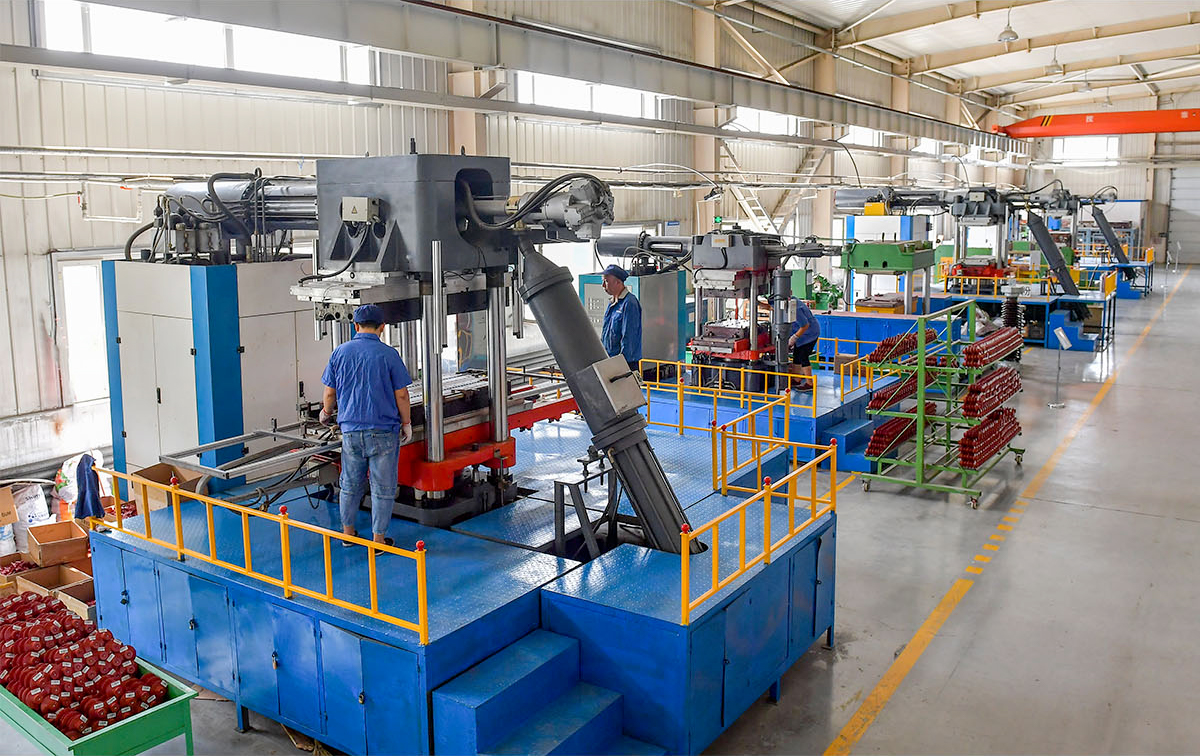
Injection vulcanization: Put the mandrel into the silicone rubber injection mold, inject the rubber, and discharge the gas generated during the process; control the temperature to fully vulcanize the silicone rubber material. After vulcanization, cross-linking occurs between the silicone rubber macromolecules, improving the material's durability. Aging resistance.
Trimming: Trim the flash on the edge of the silicone rubber umbrella skirt and the mold closing seam.
Crimping: Use a crimping machine to perform crimping. Generally, the end fittings are squeezed evenly and centripetally from 8 directions, causing slight deformation of the fittings and the mandrel, forming prestress between the fittings and the mandrel, which occurs when the fittings are subjected to tension. friction to achieve a stable end connection structure.
Sealing: Apply high-temperature vulcanized silicone rubber to the end fittings to ensure that the ends will not be invaded by external moisture. Some manufacturers can complete this step at the same time during injection molding.